
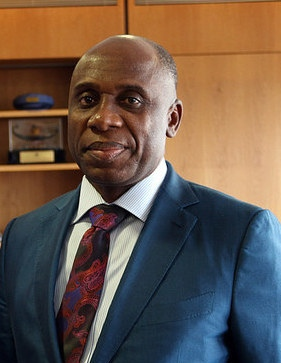

Chibuike Rotimi Amaechi is one of Nigerian politics’ most enduring and combative figures. A man who once used the courts to recover a governorship that was stripped from him, who helped orchestrate the formation of the All Progressives Congress and the historic 2015 election that ended the PDP’s 16-year federal dominance, and who went on to serve as a minister in the Buhari government for seven years, Amaechi has built a political career of considerable scope and controversy. His story is as much about determination as it is about Nigerian politics itself.
Rotimi Amaechi Biography
| Full Name | Chibuike Rotimi Amaechi |
|---|---|
| Date of Birth | 27 May 1965 |
| Age | 60 years old (as of 2026) |
| Place of Birth | Ubima, Ikwerre LGA, Rivers State, Nigeria |
| Nationality | Nigerian |
| Ethnicity | Ikwerre (Igbo) |
| Religion | Christian (Catholic) |
| Occupation | Politician |
| Education | University of Port Harcourt (BA, English and Literary Studies, 1987); studied Law |
| Wife | Judith Amaechi |
| Children | Three (Obinna, Lemchi, and Judith Jr.) |
| Known For | Governor of Rivers State (2007–2015), Minister of Transportation (2015–2022), APC co-founder |
Early Life and Background
Chibuike Rotimi Amaechi was born on 27 May 1965 in Ubima, a town in the Ikwerre Local Government Area of Rivers State, in Nigeria’s oil-rich Niger Delta region. He grew up in the densely populated Diobu area of Port Harcourt. His name carries cultural weight: Chibuike means “God is strength” in Igbo, and Amaechi means “Who knows tomorrow?” — a name that would take on an almost ironic quality given the dramatic twists his political career would take.
His father, the late Elder Fidelis Amaechi, was himself a community-level politician who attempted a councillorship during his lifetime. Rotimi grew up observing political engagement as a normal part of community life. He demonstrated leadership qualities early, eventually rising to become President of the National Union of Rivers State Students during his university years.
Education
Amaechi completed his primary education at St. Theresa’s Primary School in Ubima (1970–1976) and attended Federal Government College Okolobiri for his secondary education, where he obtained his West African Senior Secondary Certificate. He enrolled at the University of Port Harcourt, earning a Bachelor of Arts degree (with Honours) in English and Literary Studies in 1987. He subsequently studied law, adding a legal qualification to his academic profile.
Career Journey
Amaechi’s political career began in earnest in 1999, when he was elected to the Rivers State House of Assembly and served as its Speaker — a role he held for eight years until 2007. His tenure as Speaker established him as one of the most effective legislators in Rivers State history. He contested and won the PDP’s gubernatorial primary for Rivers State in 2006, but the party controversially substituted his name — replacing him on the ballot. He took the matter to court, and after a protracted legal battle that reached the Supreme Court, the court ruled in his favour and declared him the rightful PDP candidate and the winner of the 2007 governorship election. He was sworn in as Governor of Rivers State on 26 October 2007.
His two terms as Governor (2007–2015) were marked by significant infrastructure investment — schools, roads, the Rivers State University of Science and Technology, and the Rumuola flyover among others — alongside controversy and an increasingly difficult relationship with the federal centre and ultimately with the PDP itself. In 2013, he defected to the newly formed All Progressives Congress, playing a pivotal role in its formation and in the APC’s successful 2015 presidential campaign on behalf of Muhammadu Buhari. His contribution to the 2015 and 2019 election victories was widely acknowledged within APC circles.
President Buhari appointed him Minister of Transportation in August 2015, a role in which he oversaw Nigeria’s railway modernisation programme — including the Lagos-Ibadan standard gauge railway and the Abuja-Kaduna rail line — as well as port development and maritime reforms. He resigned in May 2022 to contest the APC presidential primaries, in which he came second. In July 2025, he joined the African Democratic Congress (ADC) following his exit from the APC.
Personal Life
Rotimi Amaechi is married to Judith Amaechi, with whom he has three children: Obinna, Lemchi, and Judith Jr. He is a Knight of the Holy Catholic Church (Knight of Saint John) and has been consistent in his Catholic faith throughout his public life.
Net Worth
Various estimates place Rotimi Amaechi’s net worth in the hundreds of millions of US dollars, with some sources suggesting figures approaching $750 million or more. These figures are not officially confirmed. His wealth has come primarily through his political career, real estate investments, and business interests. He has been the subject of corruption allegations over the years, all of which he has consistently denied.
Known For
Rotimi Amaechi is known for his legal battle to reclaim the Rivers State governorship; his two terms as Governor; his role as one of the founders of the APC and his contribution to the 2015 election that removed the PDP from federal power; his tenure as Minister of Transportation during which major railway projects were executed; and his Lifetime Achievement Award in Public Service received in November 2024.
Conclusion
Rotimi Amaechi is a figure whose career illustrates both the possibilities and the contradictions of Nigerian political ambition. He is a man who used the legal system to recover power when it was taken from him, who built infrastructure in Rivers State, who helped change the face of Nigerian democratic politics in 2015, and who continues to position himself for relevance in whatever comes next. At 60, with a defection to the ADC in 2025, his political story is clearly not finished.
Rotimi Amaechi’s Role in the 2015 Election
The 2015 Nigerian presidential election — the first in which an incumbent president lost to an opposition candidate — is one of the landmark events in West African democratic history. Rotimi Amaechi’s contribution to that outcome was substantial and acknowledged within APC circles, even if it has been less visible to the general public than the contributions of more prominent figures like Tinubu or Buhari himself. As one of the founding members of the APC in 2013, Amaechi was part of the coalition-building process that brought together the Action Congress, the Congress for Progressive Change, the ANPP, and the All Nigeria Peoples Party into a single opposition force capable of challenging the PDP’s 16-year federal dominance.
During the 2015 campaign, he served as Director-General of the APC’s Presidential Campaign Council — one of the most demanding organisational roles in what was an extraordinarily high-stakes political contest. Managing the logistics, messaging, and coordination of a national presidential campaign in a country of 180 million people across 36 states and a Federal Capital Territory is a significant operational undertaking. The APC’s victory, by all accounts, required precisely the kind of organisational discipline and political intelligence that Amaechi had been developing since his years as Speaker of the Rivers State House of Assembly.
Amaechi’s Transportation Legacy
The railway modernisation programme that Amaechi oversaw as Minister of Transportation between 2015 and 2022 represents arguably the most visible legacy of his federal ministerial career. The Lagos-Ibadan standard gauge railway, which reduced travel time between Nigeria’s two largest urban centres from several hours by road to approximately ninety minutes by train, was a transformation that millions of Nigerians experienced directly. The Abuja-Kaduna railway similarly connected the federal capital with Nigeria’s second-largest northern city in a way that changed both commuter behaviour and commercial logistics for the populations between those cities.
These projects were not without controversy — the cost overruns, the Chinese financing arrangements and their implications for Nigerian sovereignty, and the security incidents that affected operations on some routes all attracted criticism. The Abuja-Kaduna train attack in March 2022, in which passengers were kidnapped by bandits, was a traumatic episode that raised profound questions about the security environment in which the infrastructure operates. Amaechi’s response to those criticisms, and his record on addressing them, forms part of the ongoing debate about his ministerial legacy.
Amaechi’s Post-Ministerial Career and 2026 Legal Issues
Since leaving the ministerial post in May 2022 to contest the APC presidential primaries, Rotimi Amaechi has been navigating a more uncertain political terrain. His second-place finish in the primaries was a creditable performance but ultimately confirmed that his path to the Nigerian presidency, if it exists, would require a different political configuration than the APC’s 2022 primary structure could provide. His defection to the ADC in July 2025, following years in the APC that had become increasingly uncomfortable, suggests a man reassessing his political options with characteristic directness. At 60, with a lifetime achievement award in public service received in November 2024 and a continued public profile, he remains one of Nigerian politics’ most significant figures — whatever chapter comes next.
Frequently Asked Questions (FAQs)
How old is Rotimi Amaechi?
He was born on 27 May 1965 and is 60 years old as of 2026.
What is Rotimi Amaechi’s state of origin?
He is from Ubima, in the Ikwerre Local Government Area of Rivers State, Nigeria.
What is Rotimi Amaechi known for as Minister of Transportation?
He oversaw the Lagos-Ibadan standard gauge railway and the Abuja-Kaduna rail line, along with significant port development and maritime sector reforms.
Is Rotimi Amaechi still politically active?
Yes. As of mid-2026, he is a member of the African Democratic Congress (ADC) and is expected to be active in the 2027 general election cycle.
How did Rotimi Amaechi become Governor of Rivers State?
He won the PDP’s gubernatorial primary in 2006, but the party substituted his name on the ballot. He challenged this in court, and the Supreme Court ruled in his favour, declaring him the rightful winner of the 2007 governorship election.
